
tarpSMART | Fabrication
Welding and Bonding PVC Fabric
A welded seam in PVC is not stitched, it is fused. Done properly it is as strong as the fabric on either side of it, and it does not leak.
How the joining methods differ, which weight suits which method, and what to do when there is no welding gear on site.
Which joining method do I need?
If the seam has to be watertight, weld it. Sewing puts a hole in the fabric every few millimetres, and every hole is a way in for water.
PVC coated fabric is a woven polyester core with PVC bonded to both faces. Welding works by melting those two PVC faces together so the join becomes one piece of material rather than two pieces held next to each other.
High frequency welding is the factory method. A radio frequency field heats the PVC from inside the material, so the bond forms evenly through the full thickness. It is the strongest and the most consistent, and it is what truck curtains and marquee panels are made with.
Hot air welding heats the surfaces with air and rolls them together. Hand tools and automated track machines both work this way. It is the practical choice on site, and for long straight runs like pool covers and dam liners.
glueSMART cold bonding needs no power and no machine. It is the answer for repairs, patches, and work in places a welder cannot reach.
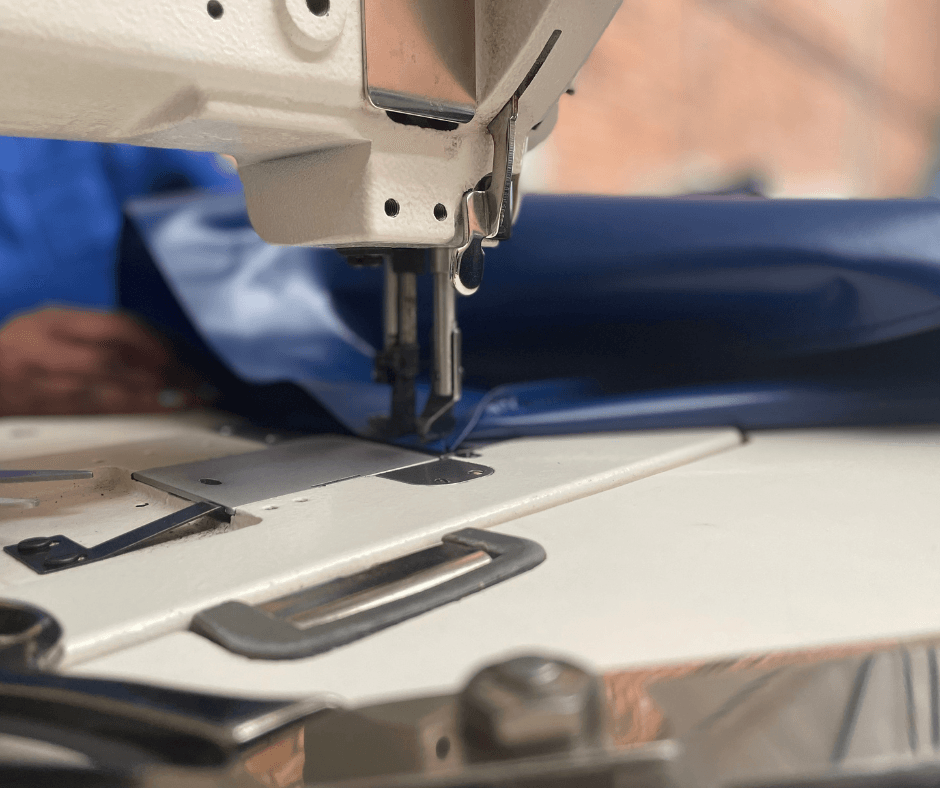
Sewing still has its place. It is how you attach eyelets, webbing, ropes and hardware, and it is the only option on 400gsm. Just seal the seam afterwards if it has to stay dry.
The four methods compared
Same fabric. Four ways to join it, and they are not interchangeable.
HF welding
High frequency | factory
Suits: 550, 700, 800gsm
Waterproof: yes, fully
Strength: as strong as the fabric
Truck side curtains, tautliners, marquee panels, anything under tension or handled daily.
The strongest and most consistent seam. Needs a machine.
Hot air
Hand tool or track machine
Suits: 550, 700, 800gsm
Waterproof: yes
Strength: high
Long straight runs, pool covers, dam liners, and repairs done on site.
Portable. Slower than HF, and more dependent on the operator.
glueSMART
Cold bonding, no power
Suits: all weights
Waterproof: yes, once cured
Strength: good on lap joints
Field repairs, patches, bag making, pool cover mending, anywhere a machine cannot go.
Needs curing time and clean, dry surfaces. Stays flexible.
Sewing
Stitched seam
Suits: all weights, and the only option on 400gsm
Waterproof: not on its own
Strength: good
Attaching eyelets, webbing, ropes, zips and hardware. Repairs where nothing else is available.
Every needle hole is a hole. Tape or seal it if it must stay dry.
Why tarpSMART welds well
Three things decide whether a seam holds, and each has a tested number behind it.
Coating adhesion
Minimum 80 newtons per 50mm, tested to BS 3424:98. That is how hard the PVC holds onto the polyester underneath. A weld is only as good as that bond, because the seam pulls on the coating, not the weave.
Flex cycles
Tested to SABS 411. A welded truck curtain is folded and rolled every day, and the fold line is where a poor seam fails first.
Melt behaviour
The PVC compound softens predictably at normal welding temperatures, which is what lets an operator get a full-depth bond without burning through the coating.
glueSMART cold bonding
For when heat welding is not practical.
glueSMART is an industrial adhesive system for joining PVC without heat. It creates a continuous chemical bond between two PVC surfaces rather than simply sticking them together, so a properly made lap joint is watertight once cured.
It is formulated for South African conditions. The cured bond resists UV and temperature swings, which is what stops a repair going brittle or yellow in the sun. It also stays flexible, so it moves with the fabric instead of cracking along the joint when the cover is folded.
Where it earns its place: on-site repairs, patching a pool cover, bag manufacture, and any custom fabrication where portability matters more than production speed.
Surfaces must be clean and dry, and the joint needs curing time before it takes load. Ask us for the working times before you plan around it.
Welding questions
Can you weld it for me?
We can assist with welding from Midrand, for wide openings and custom covers. Send the dimensions and we will come back on what is possible and what it costs.
Can 400gsm be welded?
No. 400gsm is sewn. HF and hot air welding apply to 550, 700 and 800gsm.
How wide can you weld?
Rolls come in 1.5m and 3m depending on grade, and panels are welded together to reach wider. Tell us the finished size you need.
Is a welded seam really as strong as the fabric?
A correctly made HF weld can be, because the two coated faces fuse into one piece. A poor weld is weaker than a sewn seam, so the setup matters more than the method.
Can I repair a cover myself?
Yes, for the right kind of damage. A clean cut, a puncture or a small tear is a patch job. Clean and dry the area, overlap the patch rather than butting it, and give it time to cure before the cover goes back to work.
Know when to stop. A cover torn open in a storm, damage running along a seam, or fabric that has gone chalky and brittle with age is not a glue job. A patch on a failed panel usually tears again right next to the patch. Send us a photograph and we will tell you honestly whether it is worth repairing or replacing.
Not sure which method
Tell us what you are joining
Send us the job and we will say plainly whether to weld it, glue it or sew it, and whether it is worth repairing at all. If it needs a machine we would not expect you to own, we can do that part here in Midrand.
To help you, send
- What you are making or repairing
- The fabric weight, if you know it
- The finished size
- A photograph, if it is a repair
Back to the PVC fabric range
Whatever it becomes, it works, because it starts with Smart Ikhaya.